

Aosom Alternative for Pet Owners: 2026 Picks
Table of Contents
- Why Pet Owners Look for an Aosom Alternative
- Quick Comparison: Pet-Friendly Picks at a Glance
- Durable Furniture for Dogs and Cats: What Actually Holds Up
- How to Choose Pet-Friendly Upholstery
- Cat Trees and Scratch Posts That Protect Your Sofa
- Maintaining Furniture With Pets: A Practical Routine
- Sustainability and Non-Toxic Materials to Look For
- Conclusion: Building a Pet-Friendly Home That Lasts
- Frequently Asked Questions
Last Updated: October 4, 2026
Why Pet Owners Look for an Aosom Alternative
Shopping for pet-friendly furniture usually starts with a frustrating discovery: the pieces that look great online are the same pieces your cat will shred by spring.
The real issue is the mismatch between what a product is made of and how your pet behaves.
Below, we break down what to look for, how to match upholstery to your pet's habits, and which cat furniture actually protects your sofa.
Quick Comparison: Pet-Friendly Picks at a Glance
| Product | Price | Best For | Key Feature |
|---|---|---|---|
| Pawz Road Large Multilevel Cat Tree With Hammock | $180.99 | Multi-cat homes, large breeds | 13 sisal posts, 220 lb capacity |
| PAWZ Road 4 Tier Cat Tower With Sisal Scratcher | $66.99 | Small spaces, single cats | Dual condos, removable covers |
| Pink Flower Cat Tree, 51.18-Inch | $107.99 | Style-focused homes | Acrylic bowl, plush perches |
| Cat Scratcher Massage Comb With Catnip | $45.99 | Daily de-shedding | Built-in catnip compartments |
| Pet Grooming Deshedding Glove | $44.99 | Bonding + fur removal | Flexible mitten design |
Every item here solves a specific pet problem: scratching, shedding, or both.

Durable Furniture for Dogs and Cats: What Actually Holds Up
Durable furniture for dogs and cats comes down to three things: weave density, cushion density, and frame stability.
Fabrics marketed as scratch-resistant and stain-repellent are usually tightly woven synthetics like polyester or a polyurethane blend, which resist liquid absorption and clean up with a damp cloth.
Microfiber behaves similarly: its dense surface traps pet hair on top, so a lint roller handles most of it.
Scratch-Resistant Upholstery and Durable Weave Options
Scratch-resistant upholstery is engineered so claws slide rather than catch: the tighter the weave, the fewer loose threads a claw can grab.
Look for these markers on any listing:
- Tight-weave fabric with no visible loose loops
- Synthetic leather or microfiber, both of which resist punctures better than loose linen
- Removable covers so a damaged panel can be replaced without replacing the sofa
Synthetic leather does not absorb liquids and wipes clean. The trade-off is that it feels warmer in summer.
Budget-Conscious Modular Alternatives
Modular pieces allow you to replace a single cushion instead of an entire sofa when one gives out.
A practical approach: buy a modular base in a tight-weave or microfiber fabric, then treat the covers as wear items. When a section gets clawed or stained beyond cleaning, swap that cover instead of the whole unit.
How to Choose Pet-Friendly Upholstery
How to choose pet-friendly upholstery starts with your pet, not the fabric swatch. A cat that scratches vertically needs a different material than a dog that digs before lying down.
Ask four questions before you buy:
- Does my pet scratch, chew, shed heavily, or have accidents?
- How much direct sun does the furniture get? (UV exposure dries and weakens fibers, which accelerates claw damage.)
- Am I willing to maintain it weekly, or does it need to survive neglect?
- What is the fabric treated with, and is that treatment safe for a pet that grooms itself after lying on it?
The answers narrow your options fast: a heavy shedder points to microfiber or synthetic leather, a determined scratcher to tight weaves plus a scratching post nearby, a senior pet with accidents to liquid resistance and removable covers.
Matching Fabric to Your Pet's Behavior
Read the behavior column first, then the fabric column, then the trade-off column, every pet-friendly fabric gives something up.
| Pet Behavior | Best Fabric Match | Why It Works | Trade-Off to Accept |
|---|---|---|---|
| Vertical scratching | Tight-weave synthetic, bonded leather | Claws slide instead of catching loops | |
| Heavy shedding | Microfiber, tightly woven polyester | Hair stays on the surface, lifts with a lint roller | |
| Accidents / senior pets | Solution-dyed performance fabric with a moisture barrier | Liquid beads instead of soaking into cushion foam | |
| Chewing | Reinforced seams, no loose trim or piping | Removes grab points a determined chewer can work loose | |
| Digging before lying down | High-density foam (1.8 lb/cu ft or higher) wrapped in tight weave | Holds shape under repeated compression | |
| Allergies / sensitive skin | Untreated cotton canvas, linen blends, or OEKO-TEX certified textiles | Fewer chemical finishes to react to |
Weave Density, Backing, and the Numbers That Matter
Ask for three specifications:
- Weave density.
- Backing type. A woven or knit backing holds the face fabric together and resists runs. A thin non-woven backing is cheaper and tends to delaminate first.
- Foam density. Cushion foam rated below 1.5 lb per cubic foot compresses permanently within a year or two under a jumping dog. 1.8 lb and up is the practical floor for pet households.
Non-Toxic and Hypoallergenic Considerations
Pets groom themselves with their mouths and lie with their faces against upholstery for hours, making fabric chemistry a pet-health question, not just an aesthetic one.
- Stain and water repellents. Many are fluoropolymer-based. The U.S. Environmental Protection Agency's Safer Choice program publishes criteria for safer chemical ingredients, and some furniture makers now advertise Safer Choice-recognized finishes.
- Flame retardants. Older furniture may contain halogenated flame retardants that migrate into household dust. Newer pieces often use barrier fabrics instead; ask before buying used.
- Certifications to look for. OEKO-TEX Standard 100 tests finished textiles for harmful substances. GREENGUARD Gold certifies low chemical emissions for the finished piece, which matters more for indoor air than fabric alone.
Cat Trees and Scratch Posts That Protect Your Sofa
The most effective sofa protection is not a cover but a better scratching target in the right spot. Give cats a tall, stable post near the furniture they already favor, and most will switch.
Pawz Road Large Multilevel Cat Tree With Hammock →
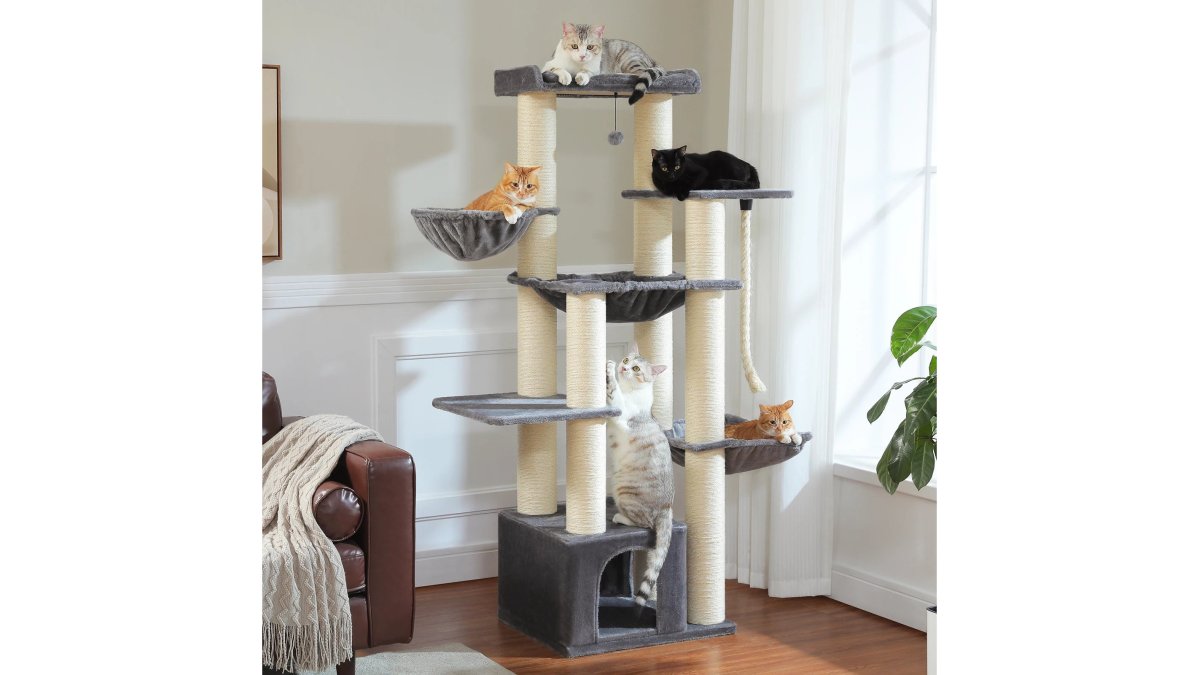
That is where a well-built cat tree earns its place. The Pawz Road Large Multilevel Cat Tree With Hammock uses thirteen 4.3-inch thick natural sisal posts and a reinforced double-layer base rated for up to 220 pounds.

Smaller spaces have options too. The PAWZ Road 4 Tier Cat Tower With Sisal Scratcher packs dual condos and a fully wrapped sisal column into a compact footprint, with removable covers for quick cleaning. If you want something that doubles as decor, the Pink Flower Cat Tree adds a clear acrylic bowl and plush perches across five levels.

Maintaining Furniture With Pets: A Practical Routine
Maintaining furniture with pets is a weekly habit, not a deep clean you get to eventually. Most damage accumulates slowly: hair works into seams, small scratches widen, spills set. A short routine stops all three, but it has to match the pet.
The Baseline Weekly Routine
- Daily: Run a lint roller or rubber brush over high-contact areas. Rubber brushes outperform adhesive rollers on embedded hair because the friction lifts hair instead of just grabbing the top layer.
- Weekly: Vacuum seams and crevices with a brush attachment. Seams are where hair compacts into felt-like mats that abrade the fabric from the inside.
- Weekly: Wipe synthetic leather and performance fabric with a damp microfiber cloth. Skip alcohol-based cleaners, which dry out and crack synthetic leather over time.
Adjusting the Routine to Your Pet's Behavior
A single schedule does not fit every household. The table below maps dominant pet behavior to the maintenance step that prevents damage.
| Dominant Behavior | Priority Maintenance Step | Why It Matters |
|---|---|---|
| Heavy shedding | Daily rubber-brush pass plus weekly seam vacuum | Loose hair mats into seams and dulls fabric |
| Clawing | Catching a pulled thread early prevents a run | |
| Accidents | Blot immediately, then enzyme cleaner; never rub | Rubbing pushes liquid into foam, where odor sets |
| Chewing | Weekly check for loose trim, piping, or zipper pulls | A chewer will find and enlarge any loose edge |
| Digging before lying down | Digging compresses foam faster than sitting |
Shedding Control Starts on the Pet
No fabric survives unlimited shedding if the pet is not groomed. De-shedding removes the loose undercoat before it lands on the sofa, cutting the surface hair load dramatically.
The Cat Scratcher Massage Comb With Catnip combines de-shedding bristles with built-in catnip compartments, which keeps most cats still long enough to finish the job. For cats that dislike combs, the Pet Grooming Deshedding Glove collects loose fur on the palm while you pet, which is easier on everyone.
Stain and Odor Response by Fabric Type
How you treat a spill depends on the fabric, the wrong method can set a stain permanently.
- Performance fabric and microfiber: Blot with a clean white cloth, then a mild dish soap and water solution. Rinse with a damp cloth and air dry. Most spills lift without a specialty cleaner.
- Synthetic leather (bonded or bicast): Wipe immediately with a damp cloth. Avoid scrubbing, which dulls the surface finish. For urine, follow with an enzyme cleaner formulated for synthetic surfaces.
- Natural fibers (cotton, linen): Blot, then treat with an enzyme cleaner for biological stains. Hot water can shrink or set the stain, so use cool water only.
Sustainability and Non-Toxic Materials to Look For
Pet owners increasingly ask what is in their furniture, not just what it looks like, a fair question, since pets spend more time on the sofa than most people do.
Three things are worth checking:
- Low-VOC finishes on wood frames, which reduce indoor air irritants
- Certified textiles such as OEKO-TEX Standard 100, which tests for harmful substances in fabrics
- Recycled or recyclable fills in cushions, which reduce waste when the piece eventually retires
The U.S. Environmental Protection Agency's guidance on indoor air quality is a useful starting point for how furnishings affect your home's air.
Conclusion: Building a Pet-Friendly Home That Lasts
Most buying advice stops at the fabric swatch. It should start with your pet's behavior, then work backward to material, frame, and maintenance routine.
At M & R Homestead, we built our selection around that idea: pet supplies and home goods that solve real household problems, backed by fast shipping and a team that answers questions before you buy. Browse our cat trees, grooming tools, and home essentials to find pieces that fit your space and your pets.
Frequently Asked Questions
What should pet owners look for in an Aosom alternative?
Focus on three things: materials, construction, and return policy. Look for reinforced bases that won't tip. Check that the retailer ships fast and stands behind damaged deliveries. A good Aosom alternative carries pet-specific gear like sisal scratch posts and grooming tools alongside furniture, so you solve the scratching problem at the source instead of just replacing damaged sofas.
What are the most durable fabrics for pet owners?
Avoid loose weaves like linen or tweed, where claws pull threads and spills soak straight through.
How do I keep my cat from destroying my sofa?
Redirect the behavior instead of fighting it. Cats scratch to mark territory and maintain claws, so give them a better target: a tall cat tree with sisal-wrapped posts placed right next to the sofa. The Pawz Road Large Multilevel Cat Tree ($180.99) has thirteen sisal posts and a 220-pound weight capacity, so it stays stable during vigorous scratching. Pair it with regular nail trims and the sofa stops being the most interesting surface in the room.
Is pet-friendly furniture worth the higher price?
It depends on how much you'd spend replacing cheap furniture. If you have a heavy shedder or a determined scratcher, the math favors buying once and buying right. Budget-conscious shoppers can start with modular pieces and add sections over time.
How does M & R Homestead compare to other home goods retailers for pet owners?
M & R Homestead stocks pet supplies and home goods in one place, so you're not bouncing between a furniture store and a pet shop. The catalog includes cat trees from $66.99, grooming tools from $44.99, and furniture built for households with animals. Shipping is fast, customer service is responsive, and the return policy covers items that arrive damaged. For pet owners furnishing a whole room, that one-stop convenience saves real time.
Furnishing a home around pets takes more than one good purchase. It takes products chosen for how your animals actually live. M & R Homestead offers a curated range of pet supplies and home goods with fast shipping, a wide selection across every room, and friendly customer service when you need a recommendation. Shop M & R Homestead and build a home that stands up to the whole household.