

Why Quality Home Furniture Is Expensive: 2026 Cost Breakdown
Table of Contents
- Why Quality Home Furniture Costs More: The Real Breakdown
- Materials: Solid Wood vs. Engineered Wood
- Joinery and Construction Techniques
- Signs of Poor Quality Furniture (And What They Really Cost You)
- Best Furniture Materials for Longevity
- Hidden Costs: Logistics, Shipping, and Supply Chain
- The Markup Breakdown: Where Your Money Actually Goes
- How to Maintain Wood Furniture and Protect Your Investment
- Cost-Per-Use and Resale Value: The Long-Term Math
- Frequently Asked Questions
Last Updated: September 23, 2026
Why Quality Home Furniture Costs More: The Real Breakdown
Quality home furniture is expensive because it is built from materials that hold up, assembled with joinery that survives daily use, and priced to reflect real labor, freight, and sourcing costs that mass-market pieces hide. This guide from M & R Homestead walks through where that money goes.
A $199 sofa and a $2,000 sofa can look identical in a photo, but one is engineered to survive a shipping container and a showroom floor, the other a decade of family life. The gap is not marketing: it is material density, joint construction, cushion fill, and freight.
Below, we break down each cost layer, show you how to spot shortcuts in a showroom, and give you the math to decide when a higher price is the cheaper choice.
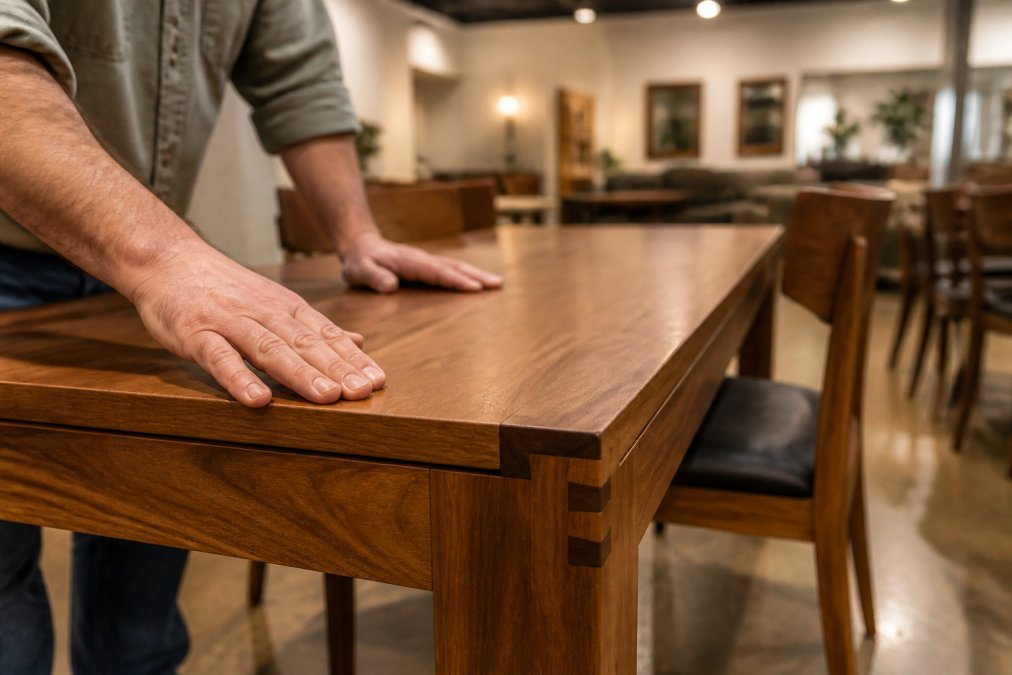
Materials: Solid Wood vs. Engineered Wood
Solid wood is cut from a single tree and milled into boards; engineered wood is manufactured from wood fibers, particles, or veneers bonded with adhesive. That distinction drives most of the price gap.
A solid hardwood frame resists racking and holds screws for decades. MDF and particle board are stable and cheap but crumble once a fastener strips. Engineered wood is not automatically bad, high-density MDF performs well in painted cabinetry, but most mass-market furniture uses low-density particle board where a solid frame belongs.
- Solid wood: repairable, refinishable, heavier, more expensive
- Engineered wood (MDF, plywood): stable, uniform, weaker at joints
- Particle board: cheapest, fails fastest at stress points
Joinery and Construction Techniques
Joinery is how the parts of a piece are held together, and it is the single best predictor of how long furniture lasts. Dovetail and mortise and tenon joints interlock wood mechanically and can outlive the piece itself; staples, glue blocks, and cam locks are fast, cheap, and fail under repeated load.
Run your hand inside a drawer: interlocking wedge-shaped teeth mean a dovetail, a line of staples means that drawer will loosen within a few years.
Signs of Poor Quality Furniture (And What They Really Cost You)
The clearest signs of poor quality furniture are wobble under light pressure, staples instead of joinery, thin veneer over particle board, and cushions that flatten within months. Each shortcut carries a cost you pay later.
- Frame flexes when you press a corner
- Drawers slide on plastic tracks rather than wood or metal runners
- Cushions lose more than a third of their loft in the first year
- Visible staples or glue squeeze-out at joints
- Finish feels tacky or uneven, a sign of rushed curing
Fast Furniture: Why Mass-Produced Pieces Fail Prematurely
Fast furniture fails because it is engineered to a price point, not a lifespan. Mass production optimizes for low material cost, fast assembly, and flat-pack shipping, thin panels, minimal joinery, and hardware that cannot be tightened indefinitely.
Best Furniture Materials for Longevity
The best furniture materials for longevity are kiln-dried hardwood for frames, hardwood plywood for panels, and high-density foam or hand-tied springs for seating. They cost more upfront because they resist the wear that destroys cheaper alternatives.
Upholstery and Cushion Quality
Upholstery and cushion quality determine how a piece feels after year three, not year one. High-density foam holds its shape; low-density foam compresses and sags. Hand-tied springs distribute weight evenly; sinuous wire sags in the middle.
Hidden Costs: Logistics, Shipping, and Supply Chain
Logistics and supply chain costs are baked into every piece of furniture, and they are far higher for quality goods. Solid wood is heavy, which means higher freight. Quality pieces often ship assembled or partially assembled, which increases packaging and handling costs.
The Markup Breakdown: Where Your Money Actually Goes
- Maker or factory sells to a brand, importer, or distributor at a wholesale price.
- Brand or importer adds freight, warehousing, duties, and its own margin before selling to a retailer.
- Retailer applies a markup that has to cover showroom rent, sales staff, delivery, returns, and warranty claims.
- You pay the sum of all of it.
| Cost Layer | Quality Piece | Mass-Market Piece |
|---|---|---|
| Raw materials | Kiln-dried hardwood, high-density foam, performance fabric | Particle board, low-density foam, commodity fabric |
| Labor and craftsmanship | Hand joinery, hand-finishing, longer build time per unit | Machine assembly, minimal joinery, high unit throughput |
| Freight and warehousing | Heavy, palletized, often assembled or partially assembled | Light, flat-packed, stacked high in a container |
| Inventory turns | Slow, months on a floor | Fast, high-volume, high-turnover |
| Warranty reserve | Higher, longer coverage, fewer claims | Minimal, short coverage, higher claim rate |
| Retail markup | Similar percentage | Similar percentage |
If a brand cannot or will not describe its supply chain, where the wood was milled, where the piece was assembled, who finished it, treat that silence as a cost signal. Transparency costs money to maintain, and the makers who invest in it are usually the ones whose margins already go into materials rather than marketing.
How to Maintain Wood Furniture and Protect Your Investment
Maintaining wood furniture comes down to moisture control, gentle cleaning, and periodic conditioning. Keep pieces out of direct sun and away from heating vents, wipe spills promptly, and dust with a soft cloth rather than a wet rag.
- Dust weekly with a dry microfiber cloth
- Clean with a damp cloth and mild soap, then dry immediately
- Condition oiled finishes once or twice a year
- Use coasters and felt pads to prevent rings and scratches
- Tighten hardware annually to catch loosening joints early
Cost-Per-Use and Resale Value: The Long-Term Math
Cost-per-use is the price of a piece divided by the years you actually use it, and it is the fairest way to compare furniture. But the sticker price is only the first number: real cost of ownership includes maintenance, repair, replacement, and, for quality pieces, what you recover when you sell.
Now add the costs most buyers never price in:
-
Maintenance. A solid wood table needs occasional conditioning and a felt pad under every lamp. A particle board table needs nothing, because nothing will save it once the surface swells.
-
Repair. Reupholstering a quality sofa typically runs a meaningful fraction of its original price but extends its life by another decade. Reupholstering a mass-market sofa usually costs more than replacing it, which is why those pieces go to the landfill instead.
-
Replacement friction. Every replacement cycle carries delivery fees, assembly time, and the risk that the next piece is worse than the last.
-
Disposal. Many municipalities now charge a fee to haul away bulky furniture, so the 'cheap' sofa can cost money on the way out the door.
-
Mass-market and flat-pack pieces typically resell for a small fraction of their original price, if they sell at all. Particle board does not survive disassembly, so the second-hand market for it is thin.
-
Mid-tier solid wood pieces commonly hold a meaningful share of their value, especially in classic silhouettes and neutral finishes.
-
Well-known premium brands and solid hardwood case goods can retain a substantial portion of their original price, and certain discontinued or collectible pieces occasionally appreciate.
- Purchase price
- Plus maintenance and repair over the period
- Minus resale or salvage value at the end
- Divided by years of use
Frequently Asked Questions
Why does solid wood furniture cost more than particle board?
Solid wood comes from a single piece of timber, which requires mature trees, careful drying, and skilled milling. Particle board is made from wood chips and resin pressed together, which is faster and cheaper to produce. Solid wood also accepts joinery like dovetail and mortise and tenon, so it holds up for decades. Particle board relies on glue and staples that loosen over time, especially with humidity changes.
What is the 2/3 rule for furniture?
The 2/3 rule suggests spending about two-thirds of your furniture budget on pieces you use daily, like a sofa or mattress, and one-third on decorative or occasional items. The idea is that daily-use pieces take the most wear, so investing in better materials and construction there gives you the best cost-per-use over time.
How long should a high-quality sofa last?
A well-built sofa with a hardwood frame, hand-tied springs, and high-density foam typically lasts 10 to 15 years with regular care. Cheaper sofas with particle board frames and low-density cushions often show sagging or wobbling within 3 to 5 years. The difference comes down to frame construction, cushion support, and upholstery quality.
How can you tell if a piece of furniture is high quality?
Check the frame material first. Solid wood or hardwood frames resist warping better than MDF or particle board. Look at the joinery: dovetail and mortise and tenon joints signal craftsmanship, while staples and glue alone are warning signs. Lift a cushion to inspect spring type, and press the foam to see if it springs back. Also check finish quality on edges and undersides, where shortcuts show.
Furnishing a home well is a long game, and the pieces that last are rarely the cheapest ones on the page. At M & R Homestead, we stock high-quality furniture and lifestyle goods with fast shipping and a friendly, customer-first experience, from indoor pieces to outdoor sets built for real weather. Browse our curated collection and find pieces designed to earn their place in your home for years, not seasons.