

7 Tips for Organizing Small Living Spaces in 2026
Table of Contents
- Start With a Decluttering Plan That Actually Sticks
- Best Ways to Organize Small Closets Without Remodeling
- Vertical Storage Solutions for Small Rooms
- Multi-Functional Furniture for Small Spaces
- Zone-Based Organization for Every Room
- Lighting and Color Tricks That Make Rooms Feel Bigger
- DIY vs. Professional Installation: What's Worth Paying For
- Simple Maintenance Routines to Keep Clutter Away
- Frequently Asked Questions
Last Updated: September 25, 2026
Start With a Decluttering Plan That Actually Sticks
Most people attack a small apartment by buying bins, filling bins, feeling productive for a week, then watching the bins become permanent furniture. The problem is not storage, it is that nothing left the room.
The 10-10-10 Rule for Small Spaces
The 10-10-10 rule asks you to handle ten items, then ten more, then ten more, rather than committing to an entire room. It works because the hardest part of decluttering is starting, not finishing.
Run it like this:
- Pick one drawer, shelf, or corner
- Pull out ten items and decide each one in under five seconds
- Repeat twice more, then stop
Best Ways to Organize Small Closets Without Remodeling
The best ways to organize small closets start with what is already on the walls. You rarely need to remove shelving or rebuild a rod system, just change what hangs where, how much hangs, and how deep the storage goes.
Measure Before You Buy Anything
A standard reach-in closet is roughly 24 inches deep, and that drives every decision. A hanger is about 17 inches wide, leaving only a few inches behind the rod, anything stored there is effectively invisible and will be forgotten.
Three measurements matter:
- Rod height. A single rod is typically set around 66 to 68 inches from the floor. That leaves roughly 40 inches of hanging space below it, which fits dresses, coats, and long shirts.
- Double-rod spacing. For a two-rod setup, the upper rod sits near 80 inches and the lower rod near 40 inches. That gives each rod about 40 inches of drop, enough for shirts, blouses, and folded-over pants.
- Shelf depth. Upper shelves should be 12 to 14 inches deep. Deeper shelves in a small closet become a place to lose things, not store them.
Rebuild in Layers
- Hang the longest items at one end so they do not block shorter ones.
- Group by category, not color, so you can see what you actually have.
- Add a second rod below the first if your closet has the vertical room.
- Move folded items to shelves above eye level.
- Keep shoes on the floor in a single row, not stacked.
Slim Hangers and the Space They Recover
Hanger thickness is the most overlooked variable in a small closet. A standard wooden hanger is roughly half an inch thick; a velvet-flocked slim hanger is closer to a quarter inch. On a 36-inch rod, that is the gap between 40 garments and 70.
Bins, Baskets, and the Depth Problem
Clear stackable bins work on upper shelves because you can see the contents without pulling them down. Opaque bins hide clutter but also hide what you own, which is how duplicates accumulate. In a small closet, visibility beats aesthetics.
Rental Constraints and the DIY-vs-Professional Line
If you rent, favor freestanding and over-the-door options entirely. Tension rods, over-the-door racks, and freestanding shelving leave no holes to patch and travel with you. Rule of thumb: if the fix requires a stud finder and a drill, it is probably not worth doing in a rental.
Vertical Storage Solutions for Small Rooms
Vertical storage solutions for small rooms use wall height instead of floor space. In most homes, the top third of a room is completely empty, and reclaiming it costs nothing but a few brackets or a door-mounted rack.
Over-the-Door and Wall-Mounted Options
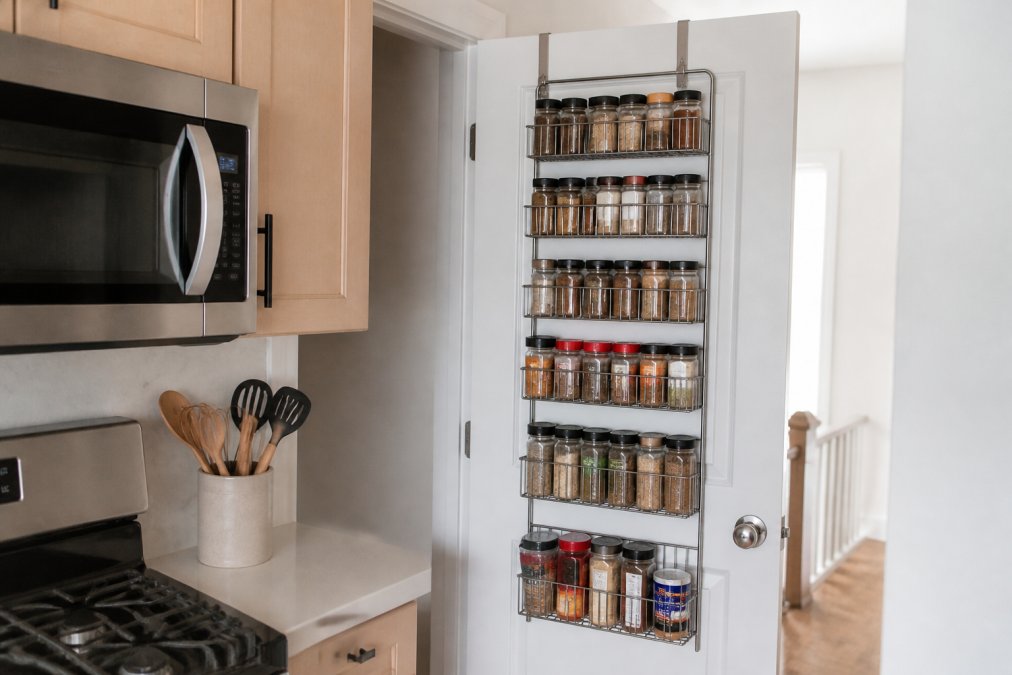
Over-the-door organizers are the fastest win in a rental: no drilling, no landlord conversation. A steel over-the-door rack with adjustable baskets turns a dead door panel into pantry or bathroom storage, and it moves with you when you leave. For example, the SucceBuy Heavy Duty Over The Door Spice Rack Organizer ($43.99) offers six generous baskets and a rigid steel framework.
Multi-Functional Furniture for Small Spaces
Multi-functional furniture for small spaces earns its place by doing two jobs at once. An ottoman that stores blankets, a coffee table with a lower shelf, a bench with a lift-up lid: each removes a separate piece of furniture from the room.
The Categories That Actually Pull Their Weight
Not every "2-in-1" piece is worth the floor space. These categories consistently earn their footprint:
Heavy Duty Pull Out Pot Lid Organizer →
- Storage ottomans. A 30-inch square ottoman holds roughly the same volume as a small blanket chest while doubling as seating or a footrest. Look for a removable lid rather than a hinged one; hinges on soft-sided ottomans are the first thing to fail.
- Lift-top coffee tables. The lift mechanism turns a coffee table into a dining or laptop surface. The trade-off is weight: a lift-top table is heavier than a fixed one, so it is harder to move when you reconfigure the room.
- Storage benches. A bench with a lift-up lid at the foot of a bed or in an entryway replaces both a seat and a storage bin. A 48-inch bench typically holds two to three folded blankets or a season's worth of shoes.
- Nesting tables. Two or three tables that tuck under one another give you a side table, a coffee table, and a plant stand without three separate footprints. They are lightweight and easy to move, which makes them a good fit for studio layouts that shift between day and night use.
- Murphy beds and wall beds. These are the highest-commitment option and the one most likely to justify professional installation. A wall bed frees the entire floor area of a bedroom during the day, but the hardware must be anchored into studs, and a failed installation is a safety issue, not a cosmetic one.
Sizing Math Before You Buy
A common pattern is buying a multi-functional piece slightly too large, then discovering it blocks a walkway. Two numbers prevent that:
- Walkway clearance. Leave at least 30 inches of clear floor between furniture pieces in a main path, and 36 inches if two people need to pass.
- Door swing. Measure the arc of every door, including closet and bathroom doors. A storage bench placed in a door swing will be moved every day until it ends up somewhere worse.
Durability Is the Hidden Cost
Where it gets complicated is durability. If you have pets, a lift-top bench with a soft fabric lid will not survive a determined cat. Look for hard surfaces, tight seams, and materials that wipe clean rather than absorb. That single filter eliminates most of what looks good in a listing photo.
- Hinges and lift mechanisms. These are the parts that break first. A lift-top table with a cheap gas strut will sag within a year.
- Upholstery seams on storage lids. A lid that is opened daily stresses the seam where the fabric meets the frame. Tight, reinforced seams last; glued seams do not.
- Caster quality on rolling pieces. A rolling cart or trolley is only as good as its wheels. Plastic casters on a loaded cart will flat-spot and drag. Metal casters with a locking brake are worth the upgrade.
The Rental Trade-Off
In a rental, favor freestanding multi-functional pieces over anything that mounts to a wall. A storage ottoman, nesting table set, and rolling trolley move with you and leave no holes. A Murphy bed or wall-mounted fold-down desk does not, and the installation cost is not recoverable when you leave.
Zone-Based Organization for Every Room
Zone-based organization assigns each area of a small home a single job, then defends that boundary. It is the difference between a room that works and one where everything lives everywhere.
Lighting and Color Tricks That Make Rooms Feel Bigger
Lighting and color change how large a room feels without changing its square footage, the angle most organizing guides ignore, and the one that produces the fastest visible result.
Three changes do most of the work:
- Lighter wall colors reflect more light and reduce the sense of enclosure
- Layered lighting at three heights (ceiling, mid-level, floor) removes the dark corners that shrink a room
- Mirrors opposite a window double the apparent depth of the space
DIY vs. Professional Installation: What's Worth Paying For
Most small-space organizing projects do not justify professional installation. Closet systems, over-the-door racks, and freestanding shelving are designed for a homeowner with a drill and an afternoon. Paying a professional for those is paying for convenience, not capability.
Where professional help earns its cost:
- Built-in closet systems that require cutting rails to length and anchoring into studs
- Wall-mounted shelving above a certain weight, where a failed anchor means damaged drywall
- Any electrical work, including adding outlets or hardwiring under-cabinet lighting
Simple Maintenance Routines to Keep Clutter Away
Clutter returns because organizing is treated as a project rather than a habit. A system that takes a full weekend to build and no daily upkeep will be gone in a month.
Four routines hold the line:
- The two-minute reset. Every evening, return anything that is out of its zone. Two minutes, not twenty.
- The one-in, one-out rule. A new item means an old one leaves the house the same day.
- The monthly surface sweep. Clear and wipe every flat surface once a month. Flat surfaces are where clutter accumulates invisibly.
- The seasonal closet pass. Twice a year, run the 10-10-10 rule through your closet again.
| Routine | How Often | Time Needed | What It Prevents |
|---|---|---|---|
| Two-minute reset | Daily | 2 minutes | Daily drift and surface pileup |
| One-in, one-out | As needed | Under 1 minute | Slow accumulation of duplicates |
| Surface sweep | Monthly | 15-20 minutes | Hidden clutter on counters and tables |
| Seasonal closet pass | Twice a year | 30 minutes | Outgrown and unworn clothing buildup |
Frequently Asked Questions
What is the 10-10-10 rule for decluttering?
The 10-10-10 rule asks you to pull out 10 items to toss, 10 to donate, and 10 to relocate to a better spot in your home. It works well in small living spaces because it forces quick decisions without overwhelming you. Set a 15-minute timer and repeat the process room by room. Most people clear a visible difference in one afternoon, and the relocated pile often reveals storage gaps you can fix with a drawer organizer or a slide-out cabinet rack.
How do you organize a small home without making it look cluttered?
Use closed storage first: drawers, cabinets, and bins with lids hide visual weight. Keep surfaces 70% clear so the eye has room to rest. Group items by zone (cooking, entry, work) so nothing wanders. Choose furniture with built-in storage, like an ottoman that opens or a bed with drawers underneath. Stick to two or three colors for bins and baskets so the room reads as calm instead of busy. A quick five-minute reset each evening keeps it that way.
What are the best storage solutions for tiny apartments?
Start with the spaces you already have: under the bed, above the fridge, inside cabinet doors, and behind closet doors. Slide-out organizers like the AEHOME 2-tier under-sink rack ($56.99) turn awkward cabinets into usable storage. Over-the-door racks hold spices, cleaning supplies, or pantry items without drilling. A 360-degree rotating trolley rack ($56.99) fits in a corner and rolls out when you need it. Measure first, then buy pieces that match your exact gaps.
Is professional installation worth it for small-space storage?
For most renters and homeowners, no. Over-the-door racks, tension rods, and freestanding shelving need zero drilling and cost far less. Professional installation makes sense only when you're mounting heavy wall shelves into studs or building custom closet systems. If you rent, stick with removable options to protect your deposit. If you own and plan to stay five or more years, a custom closet quote might pay off. Otherwise, start with adjustable, no-damage pieces and upgrade later.