

Modern Home Decor for Small Spaces: 7 Smart Ideas
Table of Contents
- Start With a Plan: Spatial Planning and Scale
- Multi-Functional Furniture for Small Spaces That Earns Its Footprint
- How Modern Home Decor for Small Spaces Uses Vertical Storage
- Best Ways to Organize Small Closets Without Adding Floor Space
- Minimalist Small Apartment Decor: Fewer Pieces, More Impact
- Lighting, Color, and Mirrors: The Finishing Layer
- Tech Integration and Eco-Friendly Choices in Compact Rooms
- Conclusion
- Frequently Asked Questions
Last Updated: September 15, 2026
Start With a Plan: Spatial Planning and Scale
Modern home decor for small spaces starts with a single decision: measure before you buy anything. Spatial planning is the practice of mapping how people move through a room, then placing furniture to protect those paths. At M & R Homestead, we see this constantly with customers furnishing compact apartments.
Scale and proportion matter more than style here. A sofa that eats two-thirds of your floor space leaves no room to live. Before you shop, sketch your floor plan on paper and mark door swings, outlets, and walkways. Anything that blocks a 30-inch path will make the whole room feel smaller, no matter how good it looks (ADA Standards for Accessible Design Title III Regulation 28 CFR Part 36 (1991)).
guide to space planning basics
Here's what most guides skip: visual weight counts as much as actual size. A glass-topped table and a chunky wood one can measure the same, yet the wood version dominates the room.
- Measure every wall, corner, and doorway
- Mark walkways of at least 30 inches
- Note windows and where light lands
- List what you actually use daily
Multi-Functional Furniture for Small Spaces That Earns Its Footprint
Multi-functional furniture for small spaces is any piece that performs two or more jobs, so you buy once instead of twice. A storage ottoman seats guests and hides blankets. A wall-mounted desk works as an office and folds away for dinner. That's the trade: fewer objects, more function.

But "multi-functional" is not automatically better. A convertible piece earns its footprint only when it replaces two items you would otherwise buy, and when the conversion takes under about ten seconds. If you have to clear a surface, unfold a leg, and hunt for a cushion every time, you will stop converting it, and you have paid a premium for a feature you never use. Run this test before you buy:
- Replacement math: Does this one piece replace at least two things on your list? If not, a simpler single-purpose item usually wins on price and durability.
- Conversion time: Can you switch it from one job to the other in a few seconds, one-handed, without moving anything else?
- Stored footprint: Where does it go when it is not in use? A fold-flat piece that slides under a bed beats a bulky one that only folds halfway.
- Weight rating: Check the stated capacity. A bench rated for 350 pounds is safe for two adults; a decorative bench with no rating is not seating.
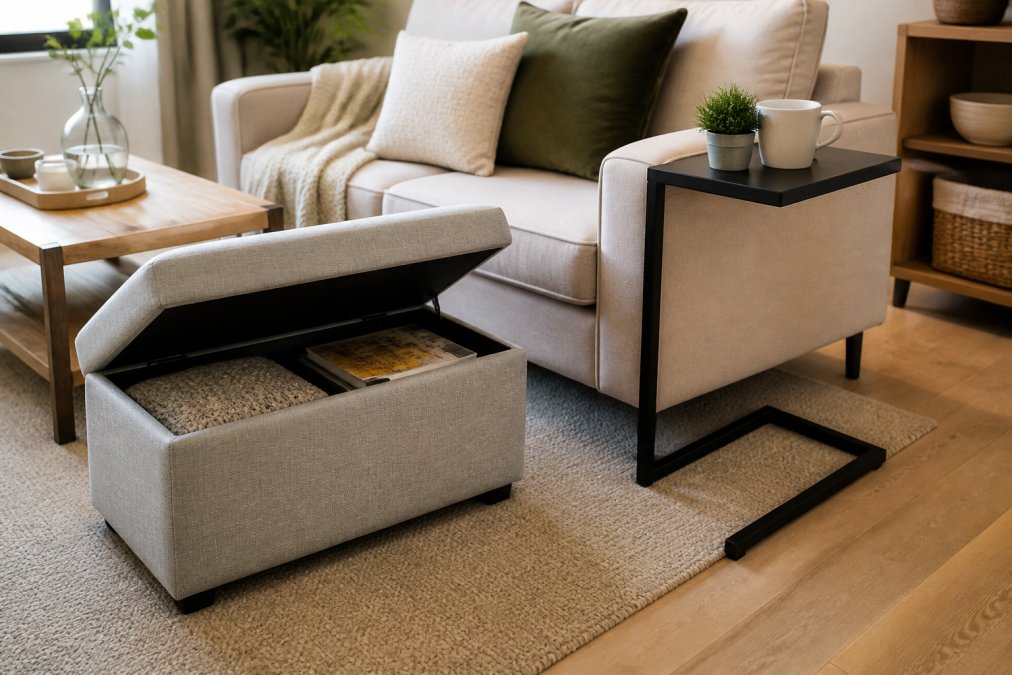
Storage That Doubles as Seating
The JHK Foldable Hidden Storage Ottoman Bench ($59.99) is the clearest example. It seats up to 350 pounds, hides bulky items inside, and folds flat to slide under a bed when you need the floor back. A common mistake is buying a pretty bench with no interior space. You lose storage you could have had for the same footprint.
Measure the interior before you commit. A bench that seats two comfortably usually needs at least 40 inches of width, and the lid should stay open on its own while you load it, a hinged lid that slams shut is a daily annoyance. For entryways, look for a bench shallow enough (around 15 to 16 inches deep) to leave a clear walking path.
Fold-Out and Wall-Mounted Desks
For a home office in a studio, the Homcom Fold-Out Convertible Office Desk ($212.99) mounts to the wall and folds out only when you work. The Tribesigns C-Shaped End Table ($104.99) slides over a sofa arm as a laptop surface, then tucks away. In practice, fold-out designs suit renters who can't drill into walls, while wall-mounted units save the most floor space.
That renter-versus-owner split is the part most guides gloss over. Wall-mounted desks deliver the biggest floor savings but require anchors rated for the load and a landlord who allows holes. Freestanding and C-shaped pieces need no tools, move with you, and cost less, but they consume floor space even when idle. If you rent and move often, weight the decision toward pieces that fold flat and pack easily.
| Piece | Price | Doubles As | Best For |
|---|---|---|---|
| JHK Storage Ottoman Bench | $59.99 | Seating + hidden storage | Entryways, bedrooms |
| Tribesigns C-Shaped End Table | $104.99 | Side table + laptop desk | Sofa and chair corners |
| Homcom Fold-Out Desk | $212.99 | Desk + dining surface | Studios, home offices |
How Modern Home Decor for Small Spaces Uses Vertical Storage
Vertical storage moves your belongings up the wall so the floor stays clear. It's the single highest-return change in a compact room, because most apartments waste the space above waist height. Open shelves, tall bookcases, and stacked plant stands all pull their weight.
Corner Shelving That Fits Awkward Gaps
Corners are dead space until you fill them. The Tribesigns 6 Tier Corner Shelf ($116.99) turns an overlooked nook into six zones for books and decor. The Tribesigns Modern 5-Tier Wooden Corner Bookshelf ($148.99) stands 69.8 inches tall on a 19.6-inch depth, so it climbs without blocking walkways.
Over-the-Door and Clamp-On Options
No drilling required. The SucceBuy Over-the-Door Spice Rack Organizer ($43.99) holds up to 20 pounds on a standard door, and the Clamp On Two Tier Desk Corner Shelf ($39.99) grips any desk up to 1.7 inches thick. The JHK Modern Wooden Open Bookcase ($65.99) adds four shelves at a compact 9.2-inch depth for renters who want a freestanding option.
Best Ways to Organize Small Closets Without Adding Floor Space
The best ways to organize small closets come down to using height and doors, not adding square footage. Most closets fail because everything sits at one level. Add a second rod, stack bins vertically, and hang organizers on the door itself. A closet that uses its full height holds roughly twice what a single-rod setup does.
Start with a purge, then sort by category, then assign each category a vertical zone. Shoes go low, folded items mid-height, rarely used items up top. Over-the-door racks extend this logic to the closet door, giving you pantry or linen storage without touching a wall.
Minimalist Small Apartment Decor: Fewer Pieces, More Impact
Lighting, Color, and Mirrors: The Finishing Layer
Layer Your Lighting Instead of Relying on One Overhead Fixture
Use Color to Blur the Edges of the Room
Place Mirrors to Capture Light, Not Blank Walls
Tech Integration and Eco-Friendly Choices in Compact Rooms
Conclusion
Frequently Asked Questions
What is the 3-5-7 rule in decorating?
The 3-5-7 rule is a styling guideline for arranging accessories in odd-numbered groups: three items on a side table, five on a shelf, seven across a larger surface. The idea is that odd numbers create visual balance without looking symmetrical or staged. In small spaces decor, it keeps surfaces from getting crowded while still looking intentional. Pair it with a neutral color palette and one accent piece per zone so the eye has a clear place to land.
How do you decorate a small space without it looking cluttered?
Limit each surface to one job. A coffee table holds a tray and one plant, not a stack of mail. Choose multi-functional furniture for small spaces so storage lives inside the piece rather than on top of it. Keep a neutral color palette across walls and large furniture, then add contrast through texture and a few accent pieces. Negative space is a design element, not wasted room, so leave gaps between objects instead of filling every corner.
What furniture pieces are best for small modern homes?
Look for pieces that serve two roles and sit close to the wall. A foldable storage ottoman bench supports up to 350 pounds and folds flat when you need the floor back. A C-shaped end table slides over a sofa arm for snacks or a laptop. Corner shelving units turn dead angles into storage. A wall-mounted fold-out desk works as both a computer desk and a dining surface, then disappears when the workday ends.
How do I choose a color palette for a small modern space?
Start with a monochromatic scheme for walls, trim, and your largest furniture piece. Keeping those tones close together blurs the edges of the room and supports the illusion of space. Add depth with translucent materials, natural wood grain, or one saturated accent color used sparingly. A neutral color palette does not mean beige everywhere; warm whites, soft grays, and muted greens all work as a base layer.
Do modern home decor for small spaces ideas work for renters?
Most do, because they avoid permanent changes. Over-the-door organizers hang without drilling, clamp-on desk shelves tighten by screw clamp, and fold-out desks mount with standard hardware you can patch later. Freestanding corner shelves and vertical plant stands need no wall work at all. If you do mount anything, use the included anti-tip bracket and keep the hardware so the wall can be restored at move-out.