

7 Best Ways to Organize Small Closets in 2026
Table of Contents
- How to Declutter Clothes for Small Closets First
- Small Closet Organization Ideas That Use Vertical Space
- Best Closet Organizers for Small Reach-In Closets
- Rental-Friendly Fixes With No Drilling Required
- Budget Tiers: What to Buy First, Next, and Last
- Seasonal Rotation and Long-Term Closet Maintenance
- Frequently Asked Questions
Last Updated: September 10, 2026
How to Declutter Clothes for Small Closets First
Before you buy a single bin or bracket, empty the closet. The best ways to organize small closets always start with subtraction, not storage. This guide walks through a recommended sequence: purge first, measure second, buy third. Skip the purge and you'll just be storing things you never wear in nicer containers.
Pull everything out and pile it on the bed. Seeing the full volume is the point. Most people underestimate how much they own until it's in one heap.
The Four-Box Method That Actually Works
Label four boxes: Keep, Donate, Trash, Maybe. Touch every item once and sort it immediately. No "I'll decide later" piles, because those piles end up back on the rod.
The rule that makes this work: if you haven't worn it in a year, it goes. Not the Maybe box. The Donate box. Seasonal items are the only exception, and those go into rotation storage, not back into prime hanging space.
What to Do With the Maybe Pile
Give the Maybe box a deadline, not a home. Seal it, date it, and store it out of the closet. If you haven't opened it in 30 days, donate it unopened. This one habit prevents the slow creep that fills small closets back up within a season.
Small Closet Organization Ideas That Use Vertical Space
Vertical storage is where small closets are won or lost. A standard reach-in closet typically has a single rod at about 66 to 68 inches and one shelf above it, which leaves the top two feet and the back of the door doing nothing (hud.gov). Reclaiming both can roughly double usable hanging space without removing a single shelf.
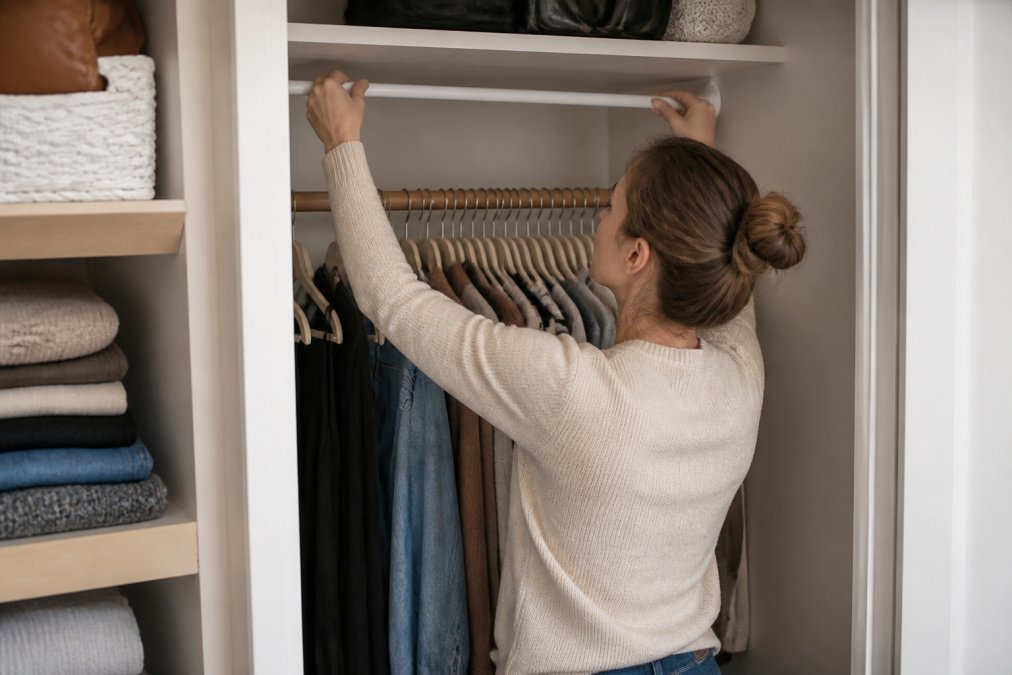
Double-Hang and Tension Rod Setups
A closet rod mounted at standard height leaves dead space above and below. The fix is a double-hang: a second rod underneath for shirts, skirts, and folded-over pants, or a tension rod above for out-of-season items.
Spacing is the whole game. Measure your longest hanging item first, a maxi dress or long coat can run 50 to 60 inches, then position the lower rod so nothing drags. A common pattern is a top rod at 66 to 68 inches for long items and a lower rod at 40 to 42 inches for shirts and folded pants, which clears roughly 24 to 26 inches of drop per tier. For a closet with a fixed shelf, a tension rod placed just under the shelf adds a third tier for shoes or folded stacks.
Tension rods need no tools and hold surprisingly well when placed correctly. The mechanism matters: a spring-loaded rod presses outward against two flat surfaces, so it needs clean, parallel walls or shelf undersides to grip. A tension rod rated for 20 to 30 pounds often holds a full run of shirts without slipping, but it may fail on textured, angled, or painted-over surfaces (homedepot.com). Rubber end caps and a quick wipe of the contact points improve grip. For heavier loads, coats, denim, use a mounted rod with brackets instead.
Over-the-Door and Command Hook Storage
The back of the door is prime real estate most people ignore. Command hooks and over-the-door organizers hold belts, scarves, bags, and robes without drilling. Door organizers with clear pockets work especially well for accessories that otherwise end up in a tangled drawer.
The trade-off is depth. An over-the-door rack adds 2 to 4 inches of protrusion, which can block a door from closing fully in a shallow closet. Measure the gap between the door and the frame before buying. Adhesive hooks are rated by weight, a small hook typically holds 1 to 3 pounds, a large one 5 to 10 pounds, so distribute heavy items across multiple hooks rather than overloading one. Clean the surface with rubbing alcohol and let it cure for the full recommended time before hanging anything; skipping the cure is the most common reason adhesive hooks fail.
The Vertical Math That Makes It Work
Before you buy anything, count your hanging items and divide by the linear inches each tier provides. A 4-foot closet rod holds roughly 48 inches of hanging space; slim hangers take about 0.25 inch each, so that rod fits around 190 shirts, but only if the items are the same length. The moment you mix long and short, you lose the lower tier. That is why the double-hang works best when you sort by length first: long items on one side, short items stacked two-high on the other. This single sorting step is what separates a closet that stays organized from one that collapses back into a single crowded rod.
Best Closet Organizers for Small Reach-In Closets
The best organizers for a reach-in closet are the ones that divide existing space rather than add furniture. Drawer dividers, storage bins, and shelf dividers turn one messy shelf into four usable zones. Start there before considering a full closet system.
| Organizer | Best For | Why It Works | Typical Capacity | Watch Out For |
|---|---|---|---|---|
| Drawer dividers | Socks, underwear, accessories | Stops piles from collapsing | 4-6 compartments per drawer | Too-tall dividers block the drawer from closing |
| Storage bins | Seasonal items, off-season wear | Stackable, labeled, movable | 20-60 quarts | Clear bins show clutter; opaque hides it but needs labels |
| Shelf dividers | Folded stacks, purses | Keeps columns upright | 8-12 inches tall | Won't grip wire shelving without clips |
| Slim hangers | Shirts, blouses | Frees rod space fast | ~0.25 inch per hanger | Velvet grips delicate knits; plastic slides |
| Under-shelf baskets | Shoes, folded tees | Uses dead space below shelf | 1-2 cubic feet | Adds depth; check door clearance |
Drawer Dividers, Bins, and Shelf Dividers
Drawer dividers stop the avalanche problem. A drawer with dividers holds the same volume but stays readable, so you actually wear what's inside. The mechanism is simple: vertical walls create compartments, and compartments prevent items from migrating. Spring-loaded dividers adjust to any drawer width; interlocking grid dividers give you more control but require a flat-bottomed drawer. Measure the interior depth before buying, a divider taller than the drawer's side wall will catch on the frame.
Storage bins handle the items you touch rarely: winter gloves, swimwear, spare linens. Label them and place them on the highest shelf. Clear bins let you see contents at a glance; opaque bins look cleaner but only work if you commit to labeling. A common pattern is clear bins for frequently rotated seasonal items and opaque bins for true long-term storage. Stack no more than two high on a shelf, a third layer becomes unstable and hard to reach.
Shelf dividers are the underrated pick. They keep folded stacks from toppling into each other, which is what turns a neat shelf into a mess within a week. The trade-off is that they need a flat shelf surface; on wire shelving, you need clip-on dividers or a thin shelf liner underneath. For purses and structured bags, a divider doubles as shape support.
Under-shelf baskets are the fourth lever most guides skip. They hang from an existing shelf and convert the 6 to 8 inches of dead space below it into a second surface for shoes or folded tees. They add depth, so check that the closet door still closes.
How to Choose Without Overbuying
Match the organizer to the failure, not the aesthetic. If the problem is a collapsing pile, you need dividers. If the problem is items you can't see, you need clear bins or open baskets. If the problem is a stack that leans, you need shelf dividers. Buying a full modular system before you've diagnosed the failure is the fastest way to spend money on storage you don't need. Start with the cheapest fix that addresses the actual problem, live with it for a month, then add the next tier only if the first one held.
Rental-Friendly Fixes With No Drilling Required
Renters face a real constraint: no holes in the walls. The good news is that most of the best ways to organize small closets don't require a drill at all. Tension rods, over-the-door racks, adhesive hooks, and freestanding shelving units all work, and all come out clean at move-out.
For accessibility, keep daily items between waist and shoulder height. Heavy bins go low. Rarely used items go high. This single adjustment makes a small closet easier to use for everyone in the household, including kids and anyone with limited reach.
Budget Tiers: What to Buy First, Next, and Last
Spend in order of impact, not excitement. The first dollar should free hanging space. The last dollar should solve a problem you've actually confirmed you have.
Tier 1 (start here): slim hangers, tension rods, drawer dividers. These cost the least and change the most.
Tier 2 (next): shelf dividers, storage bins, a door organizer.
Tier 3 (last): a modular closet system or custom shelving. Only worth it once the cheap fixes have proven what you actually need.
M & R Homestead offers a wide selection of lifestyle products, including organization essentials, so you can find items to enhance your home. Our customer service team is available to assist you.
Seasonal Rotation and Long-Term Closet Maintenance
A closet stays organized only if you maintain it. Seasonal rotation is the habit that does the heavy lifting. Twice a year, move out-of-season clothing into labeled bins and bring the current season forward. This keeps your hanging space reserved for what you can actually wear right now.
Pair rotation with a quick monthly reset: refold the messy shelf, return stray items, and check the Maybe box. Fifteen minutes a month prevents the full-day overhaul later.
The psychology here matters more than the products. Clutter builds because decisions get deferred. Minimalism in a small closet isn't about owning less for its own sake; it's about making fewer daily decisions. A closet where everything has a place is a closet you stop fighting with.
For more on space-saving approaches that hold up over time, the American Cleaning Institute's home organization guidance offers practical maintenance routines worth borrowing.
Frequently Asked Questions
How do I organize an extremely small closet?
Start by removing everything and sorting into keep, donate, and toss piles. Then work upward: add a second closet rod or tension rod to double hanging space, mount over-the-door organizers for shoes and accessories, and use slim velvet hangers to reclaim width. Drawer dividers and stackable bins handle folded items. This layered approach lets a 2-foot-wide closet hold roughly twice what it did before.
What is the best closet organizer for a small reach-in closet?
For most reach-in closets, a combination of a tension rod for double hanging plus over-the-door organizers delivers the biggest gain with no drilling. Add slim velvet hangers to cut bulk, drawer dividers for folded clothes, and shelf dividers to keep stacks from toppling. If you can drill, a wall-mounted closet system with adjustable rods and shelves offers the most customization, but the no-drill combo works in nearly any rental.
How do you maximize vertical space in a reach-in closet?
Measure from floor to ceiling, then use every band. Install a high shelf near the top for off-season bins, add a second rod below the existing one for shirts and folded pants, and hang over-the-door organizers on the outside for shoes or accessories. Stackable clear bins on the floor handle bulky items. The goal is three or four usable zones instead of one rod and a single shelf.
How can I organize a small closet on a budget?
Start with what you already own: shoe boxes as drawer dividers, a tension rod from a hardware store for double hanging, and command hooks for belts and scarves. Add slim hangers in stages rather than all at once. When you do buy, prioritize velvet hangers, one set of stackable bins, and a fabric over-the-door organizer. These three items usually cost less than a single custom closet system and cover most of the same problems.
Small closets fail for one reason: too much stuff competing for too little space. Fix the volume first, then the storage. M & R Homestead carries the hangers, dividers, bins, and door organizers that make the whole system work, backed by fast shipping and a team that actually answers your questions. Get started with M & R Homestead and turn your smallest closet into your most functional one.